Introduction
The Drunk Gambler With
Erectile Dysfunction
Searching For Something More
I was never meant to be a guru.
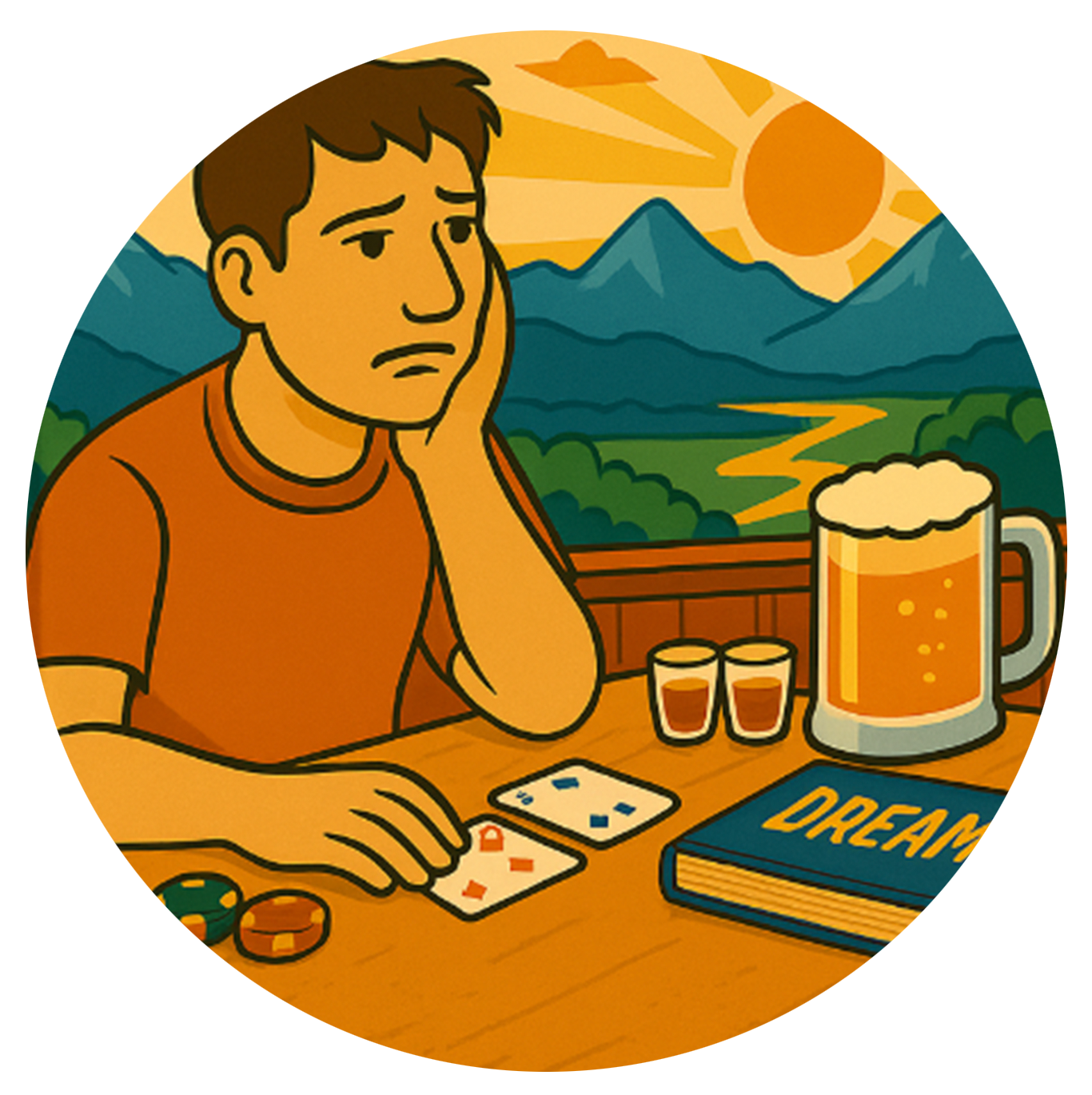
The first time I got drunk was the day I knew I wanted to stop. Eleven years later – after a drink-driving disaster, a twenty-four-hour ban from my local town, being physically assaulted in the back room of a Guildford nightclub by two bouncers, an arrest in New Zealand, delving into cocaine in the largest favela in Rio de Janeiro, becoming mildly insane from edibles in a hippie community in Australia, stealing the credit card machine from a local kebab shop, and a whole lot more – and I finally stopped.
The first time I gambled, I loved it. I bet on Arsenal to beat Southampton 3–1 on a cold night at Highbury on 4 December 1996, and it came through. Fifteen years later, having lost thousands on anything from virtual blackjack to Lithuanian basketball, I quit.
And now, twenty-nine years on from that bet, I’m still searching for more – my path, the way, contentment, purpose or whatever you want to call it. Truth be told, I don’t think we ever stop looking for something more.
I could never lead a normal life, never sustain the commuter train, the white picket fence, the Matrix.
In telling my story, I’m aware that many people are getting pissed off with all the spiritual gurus, experts and influencers telling them how to live their lives. So, as you’re maybe already pissed off with them, I figured I’d join in and do the same thing too.
Although as the drunk gambler with erectile dysfunction, I hope I’m a little more relatable. Sure, many of these gurus have a backstory, like living on their friend’s couch with only a few dollars in their pocket. But those stories rarely include the depths of spiritual and emotional hell, complete sexual failure and embarrassment, or pissing yourself in the corner of a stairwell in a tower block in a city you don’t know… with no idea how you got there.
These days, thanks to the experiences I’ve lived, I’ve reached a level of contentment, ease, confidence, passion and vision that I never thought possible. All mixed in with a healthy dose of anxiety and confusion, which I’m still working my way through.
I know I’m lucky. Not everyone is born into a situation, a country and a position where they can live all the experiences I have, make the mistakes I have, fall back on support when they mess up, and keep moving forwards. I’m very aware of this. I was born in the UK, in a very nice part of the country, into a wealthy family.
However, there are many other lucky people who could choose a different path but don’t. And there are many less fortunate people who could make better decisions that would cost nothing and even save them time and money, but don’t.
It’s the case for so many people.
People who keep drinking more than they want to. People who never try to find their purpose, stuck inside the system, doing the same commute to a job that was never their dream or passion. People who can’t stop worrying about what other people think, locked in a cycle of anxiety and self-doubt, who never feel truly at home in their own body. People who keep staring at porn rather than getting out there and trying to find a real connection.
To me, this is sad. I know; I’ve lived all of it. To many people who are following that path now, I’m mad – and that’s fine. We all live the path that we see as best for us.
I used to really care what people thought of me. Now, for the most part, I don’t give a fuck.
So why am I sharing my stories and my journey here?
Firstly, I couldn’t sleep one night, so I thought I’d start writing a book.
Secondly, I hope that if you’re searching for your meaning or your spiritual path, you might relate to my journey, find some help in it, let go of some confusions, and move closer to where you want to be. You might be taking some vices slightly too far; you might have fucked up in similar ways to me; or you might be constantly worrying about what other people think and yearning for just a little inner tranquillity.
Thirdly, confusion about sexuality, erectile dysfunction, debilitating sexual embarrassment, addiction to porn, and visiting prostitutes are still subjects that people don’t truly share or talk about, even though so many of us are going through these struggles. This leaves many people feeling confusion, shame or fear when it comes to sex and sexuality. If that’s you, this book might show you that you’re not alone: so many of the things you’re struggling with, I’ve been through too – and so are many other people at this very moment. If that’s not you, I think you’ll still enjoy the stories. After all, my first time could have hardly gone worse.
Lastly, I want to share a story that comes from the brutal and simple truth, not from the lofty position of a spiritual oracle.
In all this, I know that no single path works for everyone. The best path I’ve found – to make a load of mistakes, do a load of things right, push my limits, learn, grow, move forward, and share and understand that what’s right for me – may not be what’s right for you.
Through stories, I hope we can connect, I hope you’ll enjoy the read, and I hope you’ll learn something from it – just as I’m sure that if you wrote a book, I’d learn something from you.
*****
All the stories in this book are true. However, many of the names and some minor details have been changed to protect the identities of other people involved.
Enjoy!
The Drunk Gambler
With Erectile Dysfunction
Searching For Something More
Chapter 1:
Cocaine and Robbery:
The Search Begins
It was at Nairobi airport in Kenya that the first monumental shift in my life took place.
It was the summer of 2010, between my second and third year of university. I was twenty one. I’d gone to Nottingham to study geography. Not because I had any passion for geography, saw any real use in it, or even saw any use in going to university – simply because I didn’t know what else to do. That’s what my brother had done, and I figured, ‘Why not follow?’
After all, I had no passion, energy or guiding light at this time to conceive of doing anything else. If I could go back now, I’d drop out of university, not waste any more time there, and do something different with my life. But that’s easy for me to say now.
At university I did nothing but drink and waste my time. To describe my first two years as anything but wasted time would be a lie. Sure, I ended up with a half-decent grade, but it only took me one week to learn how to study, remember useless information and pass an exam.
To tell of all the absurd things I did during this time and my teenage years before could go on for seven chapters, but here are two that took place in my first year at university.
One Thursday, I went with Tim, a good friend from Manchester, to Cheltenham horse racing. The night before, I’d been thrown out of one of Nottingham’s nightclubs. At the time, it was called Isis – I guess this was before the other notorious group with the same name had become famous.
I don’t remember why I was thrown out, but that happened a lot in those days.
After getting a train to Cheltenham, I met Tim and we went to the races. We lost money on every race, and the only way to get over that was to go out and continue drinking. Tim ended the night in a strip club; I was too drunk to be allowed in. I can’t really remember any of it.
We were meant to be staying at a friend of Tim’s. I didn’t know the person, where their house was, or how to get there. Even if I did, I was so drunk, I wouldn’t have ended up there anyway.
The night passed, and in the morning, I was woken up in the stairwell of one of the University of Gloucestershire’s halls of residence. I had never been to that university, had no idea where it was, and God knows how I’d ended up there.
I’d pissed in the corner of the stairwell right next to the concrete on which I was sleeping, and a little urine had been soaked up by my jeans and jumper. The perfect way to start the day!
The student who found me outside his living quarters wasn’t happy. He kicked me out, insisting on searching me before I left to ensure I hadn’t stolen anything. However, it seemed that someone had stolen from me. Once outside, I realised I had no wallet, no phone, no keys – just the clothes I was wearing.
To be fair, looking back, it’s more likely that I’d lost everything through pure drunken stupidity than from theft.
I found a payphone. (This was back in the day when every payphone wasn’t a smashed-up urinal.) I called Tim, reversing the charges. Luckily, he answered. We agreed to meet in the McDonald’s in Cheltenham city centre, where we’d eaten the day before. In those days, McDonald’s was a regular dining experience and meeting point for me.
I still had no idea where I was. After asking around, I found out that the city centre was forty-five minutes’ walk in the freezing cold. We eventually met there. Tim treated me to some McNuggets and then leant me money to get back to Nottingham.
A few months later, I was pulled over by the police. Coincidentally, I’d been thrown out of the same club, Isis, that night too.
I’d gone with a friend, Jeff. We hadn’t been planning to go out that night, but at the last minute we decided we would. Isis was an out-of-town club in a shopping complex, so we decided to drive there. We got there at ten o’clock, drank a bottle of Sainsbury’s Basics vodka in the car park, then went in. I said with 100% certainty that I’d leave the car there and pick it up the next day: I would never drink and drive.
As the detectives among you have probably guessed, that didn’t happen.
When you’re smashed off your face, your decision making can become questionable. Another friend, Max, had been thrown out with me. What to do? Get a £5 taxi or drive home? It was only five minutes away. Why not?
I had the perfect solution: I knew I was drunk, so I’d drive super-slow, at five miles an hour. That way, nothing could go wrong... It was also dark, and the streets were lit, so I forgot to turn my lights on.
Two minutes later, blue lights were flashing behind me. I couldn’t help wondering how they knew I was drink-driving.
I pulled over, got out of the car, put my hands up and said, ‘You’ve got me, I’m drink-driving.’ What was the point in trying to deny it? I was smashed. They pulled out the breathalyser. I told them there really was no need, I was well over the limit; but still, it was procedure.
On the positive side, the police report said something along the lines of me being one of the politest and most apologetic drink-drivers they’d ever arrested if I remember correctly.
At least I’d learned good manners from my childhood and adolescence.
They took me back to Nottingham police station and put me in a cell. I threw up in the metal toilet, passed out, and was woken by the arrival of prison breakfast in bed: sausage and baked beans in a tin-foil tray.
I wasn’t really feeling in the mood for breakfast.
When I was let out shortly afterwards, I had to walk back to the university feeling like a true piece of shit.
A month later, I went to court with my dad, pleaded guilty, made my apologies, and got a hefty fine and a two-year driving ban. All wholly deserved, I might add, and I was genuinely sorry. The level I was over the limit by put me in the bracket to be handed community service, but luckily, I escaped that. I also had to attend a drink-driving course, where I met a load of other very messed-up characters completely lost in society – one insisting that he shouldn’t be there despite the fact that he said he had tried to attack two cops.
Now let’s get back to Nairobi airport.
Three days before that, I’d been in Brazil with Tim.
We’d been to the favela of Rocinha in Rio de Janeiro. Rocinha is South America’s biggest favela, and it has one of the most beautiful views of the Atlantic Ocean you’ll ever see. In Rio and in many other parts of South America, the favelas have the most incredible views, because they’re built on the hillsides. The flipside is that these zones are usually underdeveloped because they’re geographically unstable.
The favelas of Brazil are also where you can meet some amazing communities of incredible people doing their best to get by and help one another. The story I’m going to tell here involves a small minority of these areas, where the social problems are made worse by, well, people like me.
We didn’t go to Rocinha with an organised tour guide. We went with a guy who knew a guy from there, Ricardo, who knew the backstreets.
We met some gang members, held their machine guns, and saw a sizeable amount of cocaine. The photos of us with the guns were even on Facebook at one point; thankfully, they’ve disappeared now. We had to leave a little extra cash for this ‘privilege’, which was no doubt used to finance that way of life and the drug wars that are still going on today.
Afterwards, we went to a local bar down a side street. I was twenty years old, and cocaine was one of the few things I’d never tried. So, I thought, ‘When better to try it than in the backstreets of a Brazilian favela ravaged by past violence and conflict, partly due to the fight for control of cocaine?’
I loved it! I was full of life, full of energy, full of confidence to talk shit about whatever I wanted. I knew it was all bullshit that would wear off to a horrible low after a while, but as a clueless twenty-year-old lost in the moment, who cared? Except we were in the middle of the favela, a long way from our hostel, and it probably wasn’t a good place to be high off my face.
As may be expected, after the initial sensation wore off, I only wanted more. We were with a few people who had more sense than Tim and I did, and they wisely decided it was time to find our way back to the main street and take a taxi back to our hostel – Mellow Yellow, next to the Cardeal Arcoverde Metro station in Copacabana. Fortunately, we listened and followed – extra gear in pocket, of course.
The journey back to the hostel went surprisingly smoothly, given where we were, but the party only continued there. I couldn’t get enough of the cocaine. Tim tried to make me stop, locking me out of the toilet while he indulged. But I climbed over the top of the cubicle. I wanted more! And I was going to get more! He gave in and left me a little.
I ditched the traditional bank note and ground my face onto the toilet seat, snorting up every last bit I could before coming out looking like a snowman. Tim dusted my face and body off, and we went back out to the bar.
For some inexplicable and truly dickheadish reason, a little after that, I went to our hostel dormitory, threw a load of load of things around – some mine, some not. I was like a messed-up rock-star with none of the glamour and all of the shame. Needless to say, I pissed a whole load of people off.
Half of the rest of what happened, I can’t remember. I couldn’t walk properly the next day because my right foot was killing me. It was completely swollen.
Thankfully, we were leaving that day. We also hadn’t paid our bill. This was the perfect excuse to keep our heads low, sneak out of the hostel, do a runner without paying, and take a taxi to the airport.
Another truly dickheadish move.
When you add the comedown from the coke, alcohol, awful behaviour and so much more from the previous two weeks to a twelve-hour overnight flight back to London before then heading to Nairobi shortly after, this really was rock bottom.
Back to Nairobi airport. I was off to Malawi to volunteer with a microloan charity for three weeks. Yes, that’s right: the white person who had done all the things I’ve confessed in this chapter was off to support black people in poverty in Africa.
I truly felt like shit. How could I not? I deserved to feel like shit.
There I was, sitting outside a tiny bookstore in the airport. I looked up, and my eyes rested on a self-help book. The first I’d ever seen.
It was Robin Sharma’s Life Lessons from a Monk Who Sold His Ferrari.
It called me in; I bought it and instantly began reading it. And in that moment, it felt like I had finally found a place of hope, some refuge. A guide. My bible, if you must!
From what I remember, it was a list of one hundred steps that could help you change your life. I really tried to follow them. Help people, live in the present, exercise, eat well. It’s often those basic and obvious things that we forget in our darkest times that we first have to get back to.
To clarify, I was an extreme binge-drinker, not an alcoholic. I could happily go without drinking all week or all month if I stayed at home, but nearly every time I went out, I’d end up at the stage of blackout or worse.
The people I spent time with at this point were similar to me in their drinking habits and life choices, though perhaps to a less extreme level. I did my best to hide much of it from my parents, lying to them about many things, but I’m sure deep down they felt something was wrong and they were worried.
Mostly, though, I got by. The majority of the time I was a nice, kind, timid kid. But I lacked a huge amount of self-confidence and a healthy dose of self-control when under the influence.
My behaviour around drink and drugs was an attempt to mask the complete lack of self-worth that I’d developed from childhood and through adolescence. It never worked – it only made things worse – but at least for a few hours, there was some escape. When I stayed at home, I was so far inside my tiny comfort zone that I was protected, but that wasn’t what I wanted to do. Staying in, I was unbelievably lonely. This is a conundrum faced by so many today.
All this made my three weeks in Africa a good time to make a change and try something new. I wouldn’t be drinking or doing anything else – just trying to help (or perhaps better put, not get in the way too much). From a personal point of view, it was an amazing experience.
I stayed with a local guy, Chippie, and his family in a mud house. I followed him around at the charity, I met a lot of locals (who loved meeting a foreigner), and the charity really did do some great work.
It felt good. I felt better. I realised that you can’t rub out the mistakes of the past; they’re what make you who you are today. That was my big lesson from this time, and it was worth it just for that. I’d had good moments from the past too, but it was the bad ones that had stuck.
Over the next few years, I read several other self-help books as the industry boomed. They certainly helped me and gave me a little light that I was searching for at times.
But even though each book I read gave me a little boost, none of them took me to the root of the problem or helped me find the real answers I was looking for. And I often ended up in a cycle of reading book after book, repeating bullshit positivity after bullshit positivity, and forgetting half the ‘lessons’ I learned a few days on, often ending up with more questions than answers.
That said, I’ll be forever grateful for Sharma’s book, because in my ultimate low it gave me a way forward, with some practical advice I could use to dig myself out of the hole I’d created for myself. Mixed with the motivation that I never wanted to go back to the state I’d just been in, it worked: from here onwards, I began to take the first steps towards overcoming the gremlins deep inside me. There were many to overcome, and many more mistakes to make – but from this point, the will to overcome them was there.
To make some amends for my behaviour in Brazil, I returned to Rio five years later in a much better state and went back to the hostel to admit what I’d done and pay what I owed. I doubted they’d even remember me or have the information, but I’d calculated the rough amount and fully intended to pay it back.
When I arrived at the door, the hostel had closed down. This made me feel bad. Was I to blame? Perhaps to a small degree.
I instead donated the money to the Ayrton Senna Foundation. Senna is a hero of mine as he is for many Brazilians, and the foundation offers great opportunities for the youth of Brazil. With my donation, I explained exactly what I’d done and why I was donating that amount.
Did it cancel out the past? No. But it was the closest thing I felt I could do to make amends.
Reflection #1: The Past Is in the Past
The lesson here is the old cliché: The Past Is in the Past
Sure, I’d brought drugs into the hostel, gone out of control and then did a runner without paying my bill…
I’ll hold my hands up: that’s not good in anyone’s book, especially my own. But until someone invents a time machine, I can’t change that. And sitting in a pile of shit feeling awful about it only made things worse.
There came a point where I had a choice to make: do I stay there repeating the same shit again and again, or do I stand up and finally make a real decision to change?
When I made that decision, life began to shift – mostly upwards, but also downwards, sideways and in roundabouts too.